From a real workflow
to a working AI prototype in three days.
The Workprint™ framework: Brief. Find. Shape. Build. Your people map how the work is really done, find where AI fits, and build it in the tools you already pay for.
Built for any size of team
Start with one workflow. Add teams when it works.
Small teams
A team, or a firm of under 50, that wants AI working on one real job, quickly.
Open day or workshopGrowing firms
Firms of 50 to 1,000 people with the licences in place and no clear next step.
Workshop or programmeLarge organisations
Several teams that need one shared method, so the wins add up.
Programme or rolloutBought the licences. Still waiting for the change.
Four stories we hear from teams of every size.
Licences, no change
Everyone has the tools. The work looks the same as it did last year.
Training that doesn't land
Prompt tips on made-up examples, and nothing carries over to Monday.
Ideas that never ship
A brainstorm fills a wall with use cases. Six months later, none of them is built.
Pilots that stall
The proof of concept works in the demo. Then it sits there with no owner and no budget.
Most AI plans start with a blueprint. The Workprint framework starts with how the work is really done.
A blueprint shows what someone plans to build. The real work has workarounds, waiting and steps only one person knows. That's where AI helps most, and it's the part most plans skip.
Four steps. Each one ends with something you keep.
The full programme runs them over three days. Every step has named tools your team can reuse on the next workflow.
- 01Day 1, morning
Brief
Your team writes down what AI needs to work the way you do: who reads the output, what good looks like and the rules that never bend.
- Context Canvas
You leave with A context pack any AI tool can use
- 02Day 1, afternoon
Find
Your team maps one real workflow as it is done, not as it is described, and marks where the time and the errors go.
- Friction Lens
- Work Replay
- Opportunity Filter
You leave with One opportunity, mapped
- 03Day 2
Shape
You score the ideas for that opportunity, decide who does each step once AI is in, and choose whether to build, buy, partner or pilot.
- Prioritisation matrix
- Target state map
- One-page blueprint
- Five-factor call
You leave with A scored shortlist and a blueprint a builder can price
- 04Day 3, remote
Build
Your team builds a first version in the AI tools you already pay for, tests it against real cases and pitches it.
- Prototype sprints
- Test set
- Proposal and pitch
You leave with A working prototype
See what you walk out with
Two of the deliverables, filled in for an invented workflow: turning a sales call into a proposal.
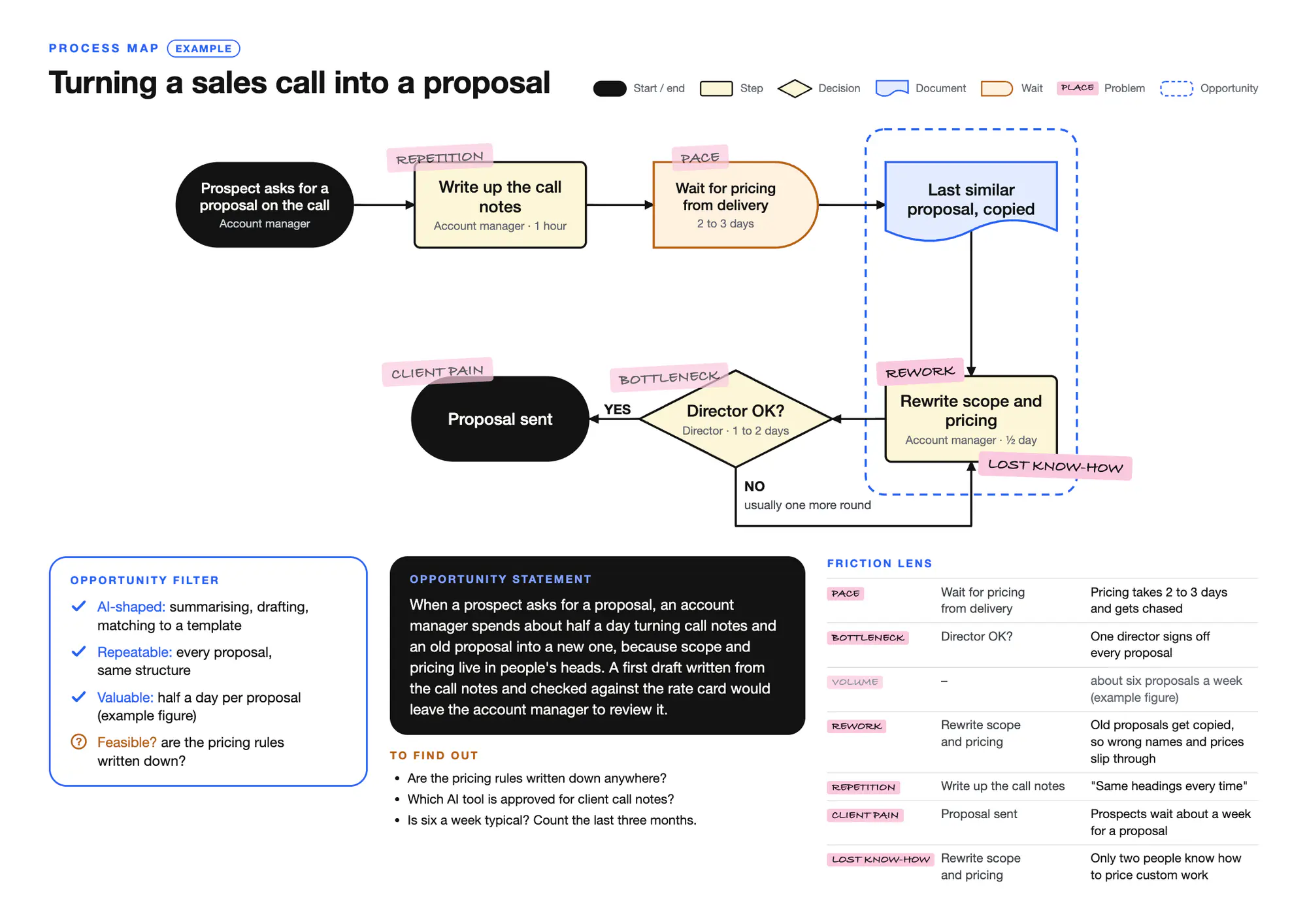
Sample one-page blueprint, from the Shape step
Proposal first draft
- The job
- Turn call notes into a first-draft proposal the account manager checks and sends.
- Who uses it
- Account managers, after every discovery call.
- What goes in
- The call notes, the proposal template, the rate card and three past proposals that won.
- What comes out
- A two-page draft with scope and prices, plus a list of anything it couldn't price.
- Who checks it
- The account manager checks every line. The sales director approves any price that isn't on the rate card.
- How it's tested
- Ten past calls and the proposals that went out. The drafts must match their scope and prices.
- The call
- Pilot it for four weeks in the AI tool the team already uses.
Try step one for free
The Context Canvas turns seven short answers into a context pack any AI tool can read. It runs in your browser and nothing is uploaded.
Open the Context Canvas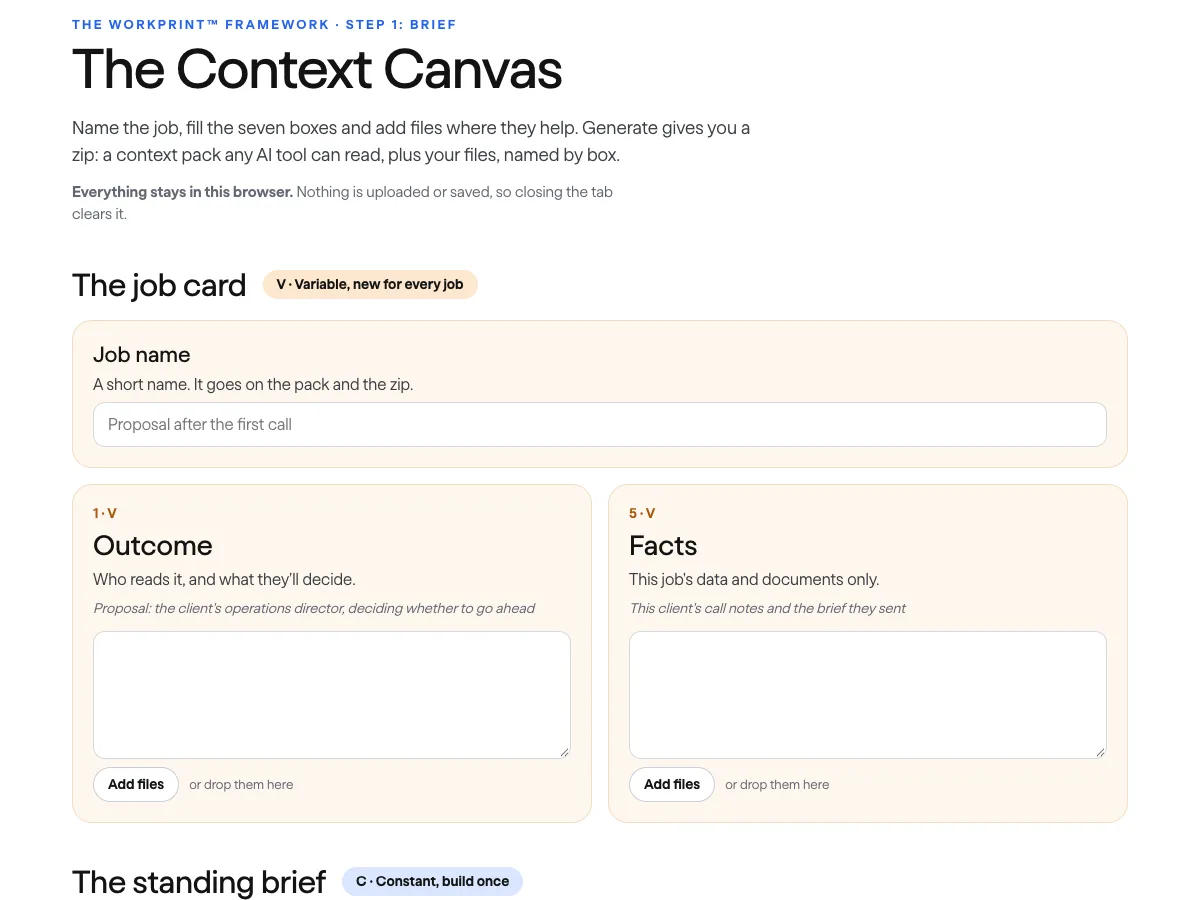
Ways to work with us
Start with one workflow and grow from there. We scope every engagement on a call first.
Workprint open day
Small firms, one workflow per firm.
One day, on public dates
- One workflow mapped
- One opportunity chosen
Priced on a call
Ask about datesWorkprint workshop
One team of up to 15 people.
One day: Brief and Find
- A context pack
- A process map
- One opportunity chosen
Priced on a call
Talk to usWorkprint programme
One team, in a company of any size.
Two days in the room, one day building remotely
- A context pack and a process map
- A blueprint a builder can price
- A working prototype and the case to fund it
Priced on a call
Talk to usWorkprint rollout
Several teams.
The programme for each team, plus 90 days' support
- One method across teams
- A prototype per team
- Support while it beds in
Priced on a call
Talk to usThe team behind it
Trainers who build
We build with AI every day: our own products, client systems and this website. Your trainers do the work they teach.
Delivered at enterprise level
We designed and delivered a six-week AI training programme for senior product managers at a Fortune 500 tech company, with a training partner.
Partner-level depth
Fautons is part of Anthropic's Claude Partner Network, and founder Waseem Bashir has worked in AI since 2008.
Questions teams ask us
An AI adoption framework for teams. It finds the work AI should do in your team, then builds it, in four steps: Brief, Find, Shape, Build. Each step has named tools and ends with something your team keeps, from a context pack to a working prototype.
The ones you already pay for: ChatGPT, Claude, Microsoft Copilot or Gemini. Your team builds the prototype in those tools, so it keeps running after we leave.
No. A small team can start with an open day or a one-day workshop. Larger firms run the full programme with one team, then roll it out team by team.
The people who do the work, plus the person who owns it. They know where the time goes, and they are the ones who will use what gets built.
One real workflow that takes too long, a few examples of good work, and access to the AI tool your company has approved.
Prompt training teaches the tool. The Workprint framework starts from your workflow, finds where AI fits and ends with something built and tested on your own work.
You keep the context pack, the map, the blueprint and the prototype. To run the method across more teams, the rollout adds 90 days of support.
Bring one workflow.
We'll help you build it.
Tell us which work takes too long and how big the team is. We'll suggest the right format and come back with a plan and a price.
Workprint™ is a trade mark of Fautons Ltd.